Living with Crohn’s Disease can be challenging. So, traveling with Crohn’s Disease is definitely not for the faint of heart. I have had Crohn’s Disease for 15 years and I love to travel.
*Some links in this post are affiliate links, which means that if you click a link and complete a purchase, I may receive a small commission at no extra cost to you. I appreciate your support of PXD! Read my full disclosure here.
My goal is to help others with the knowledge I’ve gained in the past 15 years of traveling while living with Crohn’s Disease. This includes helping those looking for ways to support someone they know with Crohn’s Disease (or Ulcerative Colitis). Keep reading for my tips.
1. Plan Your Food Intake
Avoid any possible food triggers a few days before your trip. This will help you to feel better on your travel day. My personal food triggers are meat and vegetables. A few days before I’m going to travel, I start cutting out all animal proteins and vegetables.
2. Pack Food From Home
Many people like to travel with items such as nuts, potato chips or popcorn. These contain hard kernels, lots of grease or are just plain hard to digest. For a lot of people with Crohn’s Disease, these snacks just won’t work. I love to bring foods that are non-perishable and that don’t take up a lot of space.
My go to item is Trader Joe’s cereal bars. I also pack Trader Joe’s fruit leather strips, Pop Corners brand corn chips or anything else that is easy to digest and easy to pack.

Couscous, a Middle Eastern grain, is also a quick and easy meal to make while traveling. It’s easy to digest and won’t take up a lot of room in your luggage.

Another food item I always pack is a box of Kate Farms nutrition shakes. These are great for when you have stomach issues and aren’t able to eat solid food. They use pea protein and are much healthier (in my opinion) than a lot of popular nutrition shakes. The variety I use have over 400 calories per serving.
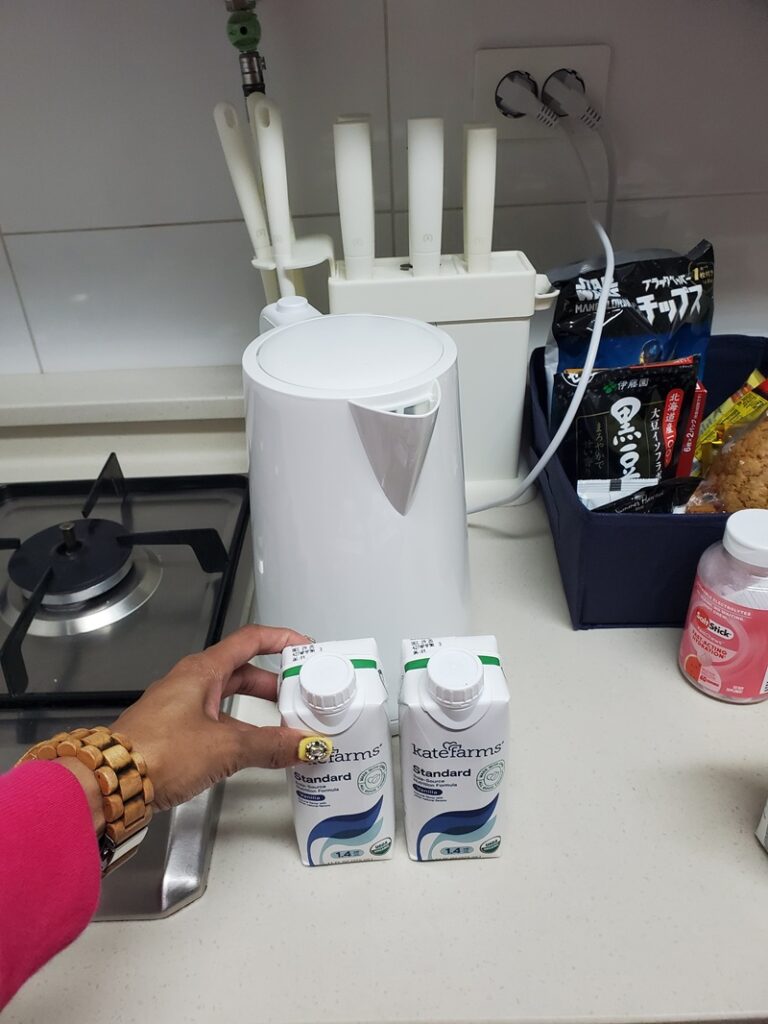
Kate Farms nutrition shakes are available for purchase at select stores. However, due to my Crohn’s Disease, I have them prescribed by my doctor. They are delivered to me by a specialty pharmacy.
3. Pack Loose-Fitting Clothing
Travel in loose fitting clothing such as harem pants or yoga pants. This is especially necessary on long flights. When you are bloated on a long flight, you want to feel like you’re wearing pajamas. Wearing jeans or trousers will make you feel constricted.

If you prefer, wear jeans or trousers in the airport. Then you can change into your other pants when you’re on the plane.
4. Use a Restroom Locator App
Restroom locator apps are great for locating a bathroom quickly. You can also use them to locate the restrooms that will be on your travel route. Most of these apps allow you to download specific location maps so you can customize the app to your destination.

Certain destinations have clean and well-maintained bathrooms everywhere you go. Japan is one of those countries. It’s my top country for traveling with Crohn’s Disease!
5. Be Careful When Eating Out
Street food is common in many popular destinations. However, many times there is no sink or other way for the owner to keep things sanitary. When you have a sensitive digestive system, the slightest microbe can throw your whole system off track. Be careful when it comes to these types of places. Is there a sink? Does the food server where gloves? Take note of these things as you decide where you will eat.

These same rules apply to all types of restaurants. Also, do you notice a steady flow of customers going into the restaurant? Or is the restaurant completely empty during prime eating times?
Lots of traffic means that the food is fresh. This means there is a better chance that you will not be eating food that has sat around and could possibly make you sick.
6. Travel With All of Your Medicine
Over the years of traveling with Crohn’s Disease, I have been on many different medicines. In the past I had capsules that were very easy to travel with. Later on, I gave myself injections. This was harder because I needed to carry my medicine in a refrigerated lunch bag.
One time I was going through airport security with my ice packs that had defrosted. They were considered large liquid items in my carry-on luggage and were not allowed. I almost missed my flight home.
In this case, preparation is key. Find the right bag or container to carry your medicine. Some are labeled as insulin carrying cases. Those cases fit most injection pens too.

There are many new containers that are able to keep medicines refrigerated without using ice packs. Some use USB power. If you do choose to bring ice packs, give yourself more time to get through airport security. When they do defrost, the airport security will perform tests on them. This is why extra time is so necessary.
At another point, I took my medicine through an IV, so I would plan my trips around my infusion sessions. If you take medicine this way, give yourself a few days between your infusion session and your travel plans. This way if you don’t feel well right after your treatment, you have a few days to recover.
Currently, I am giving myself injections again. However, now I have an idea of what to do and how to transport my needle pens. And fortunately, I only inject every four weeks, not every two weeks, like in the past.
7. Try Natural Remedies
There are a few natural remedies that I carry whenever I travel. I always carry ginger candies with me. Ginseng candies are another great option. Both ginger and ginseng are root plants from the same family. They help whether it’s an upset stomach, nausea or indigestion.

I also pack ginseng tea. if you eat something that messes with your system, take a cup of ginseng tea.

8. Pace Yourself
Do not try to completely fill your schedule when traveling. If you overextend yourself, it could lead to a flare up.

Take days off during the trip just to rest your body. It can feel embarrassing to have to do this, especially if you are with a group. Don’t let that stop you from taking care of yourself.
If you completely wear yourself out, you will be less likely to want to take more trips in the future. Pacing yourself is so important.
9. Be Prepared For Possible Hospitalization
No one wants to think about being hospitalized in an unfamiliar place. When you have a chronic illness, it’s best to be prepared no matter where you are.
I had to visit the ER in South Korea in April 2025. I was in so much pain, I had missed my flight home, and it all happened the day I was checking out of my Airbnb. So that meant I had nowhere to stay. For the full story, read my post on 5 Tips for Going to the ER in a Foreign Country. Below are a few things I wish I had done during that time.
Create instructions beforehand of what should be done if you need to be hospitalized. This includes any allergies/medicine interactions that you are aware of.

Do research as to the types of medical facilities available in the places you will be traveling to. Many places are very different from where you live.
Invest in travel insurance. It’s generally inexpensive and will give you peace of mind. This is the peace of mind you need when you have a chronic disease. Getting sick in an unfamiliar area is not a game. You can get travel insurance through your airline when purchasing tickets or through an insurance company. If you’re interested in seeing what travel insurance actually covers for your specific trip, click the button below.
10. It’s Okay to Not Feel Okay
I think the scariest thing about traveling with Crohn’s Disease is being afraid of feeling “not okay.” That is okay. And it’s a perfectly normal feeling.
I’ve been on flights (some of them very long) where I felt very sick. All I wanted to do was wrap myself up in a blanket and be alone. But you’re not alone. You’re with 300 strangers. You may get to your destination and need to rest. Maybe your pace isn’t as fast as other travelers around you. That’s perfectly fine.
A Final Note
I hope this post eased some of your worry about traveling with Crohn’s Disease. While not 100% easy, it is possible for a lot of us to travel despite this illness.
I am not a medical professional. Anyone with a chronic illness should consult their doctor before planning any type of trip they’ve never taken before. According to the CDC, some medicines can make individuals more susceptible to travel-related infections.
In any case, I hope you are able to ease out of your comfort zone and travel as far as you possibly can.